
Governance and Digitalization (GD)
Table of contents
University budget for sustainability effort (in US Dollars)
The RMUTP budget for sustainability effort for 2024-2026 are shown as below.

Description:
The average percentage university budget for sustainability effort is 1.42 %
Sustainability Report (GD.3)
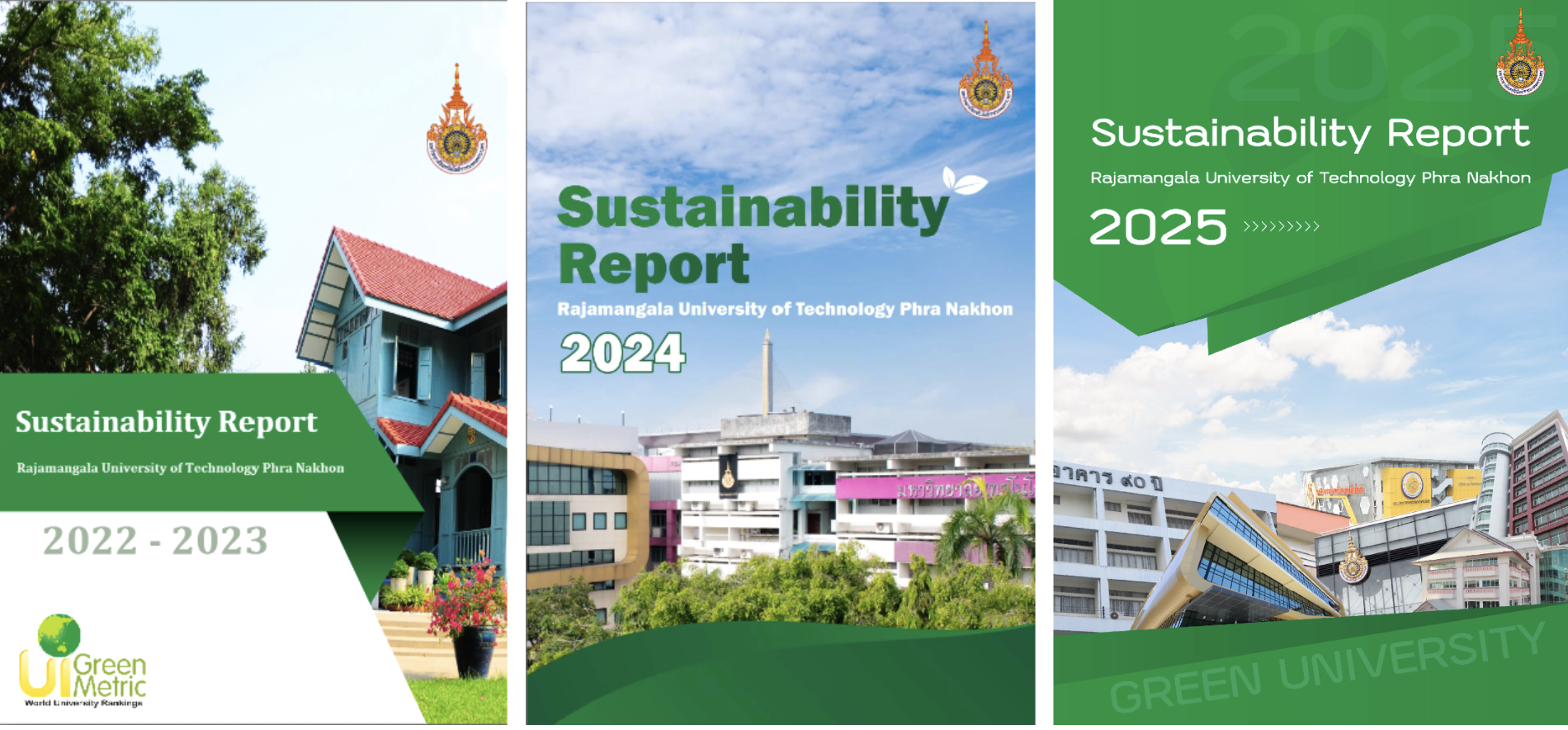
Sustainability report 2023-2025 (UI GreenMetric indicators)
SDGs reporting
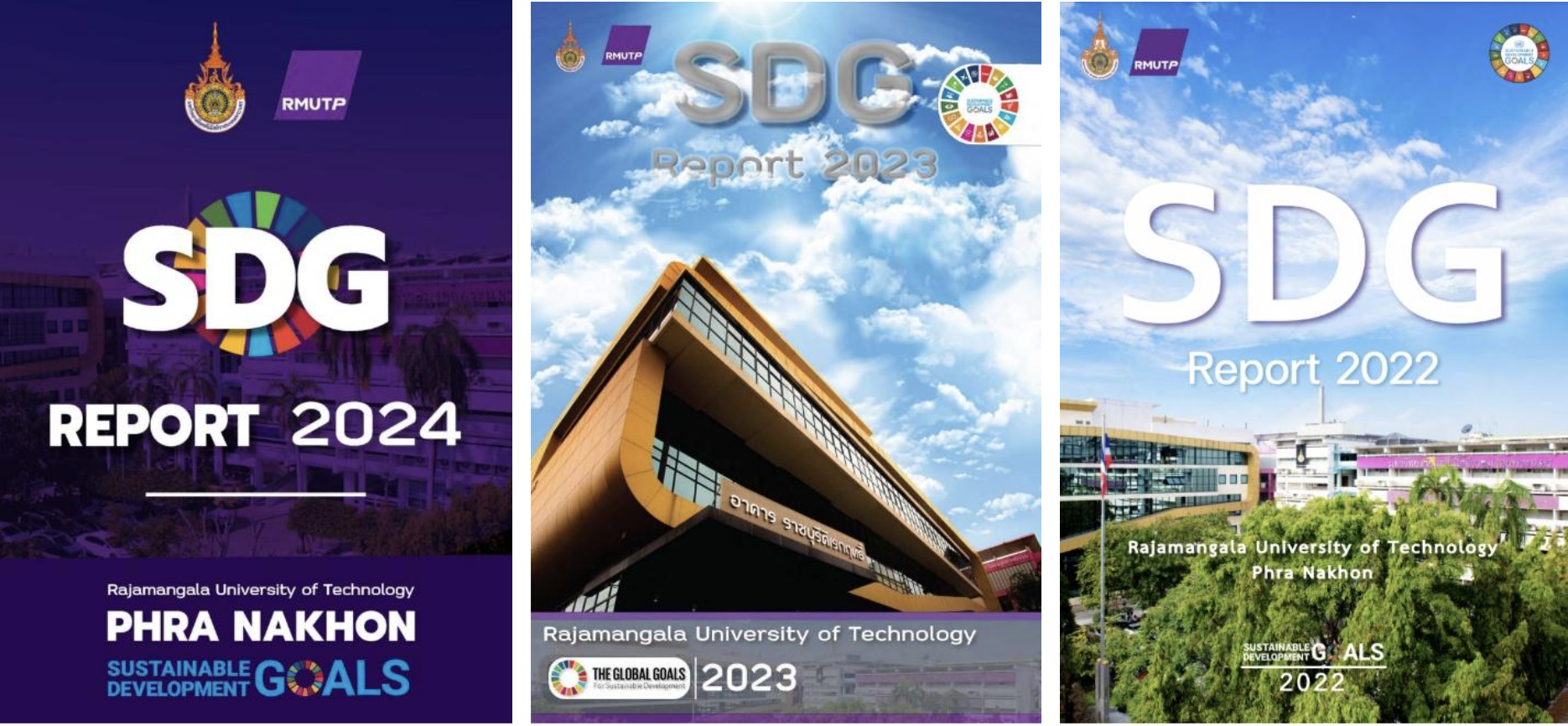
RMUTP systematically compiles and reports sustainability-related information through its Green University, UI GreenMetric, and SDGs reporting processes. The information includes policies, activities, implementation results, and supporting evidence related to infrastructure, energy, waste, water, transportation, education, research, governance, and SDGs contributions. This reporting approach supports transparency, performance monitoring, and continuous improvement of the university’s sustainability operations.
Financial Report (GD.4)
Description:
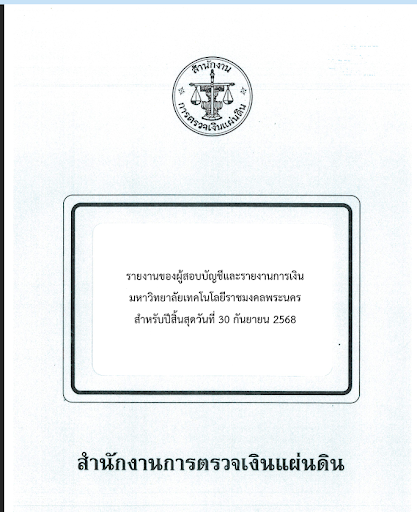
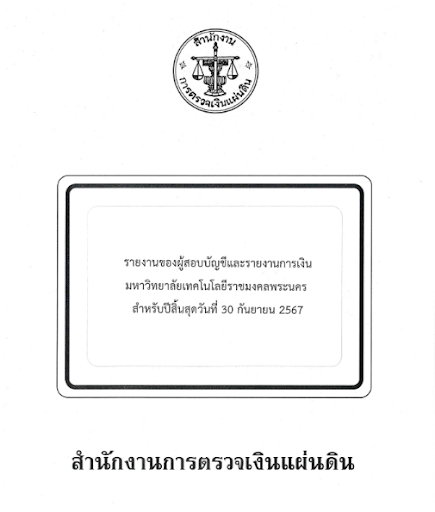
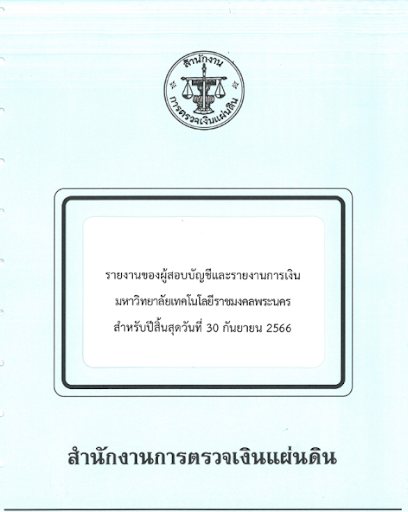
Rajamangala University of Technology Phra Nakhon (RMUTP) publishes its official financial reports annually through the website of the university’s Finance Division, Office of the President. The reports include the Auditor’s Report and Financial Statements of RMUTP for each fiscal year and are publicly accessible online.
The university’s financial reports are audited by the State Audit Office of the Kingdom of Thailand, an official government auditing body. These reports present the university’s financial position, financial performance, revenue, expenditure, and related financial information for the fiscal year. The publication of these reports demonstrates RMUTP’s commitment to transparency, accountability, and good governance in financial management.
The most recent financial report available on the Finance Division website is the Auditor’s Report and Financial Statements of RMUTP for the year ended 30 September 2025, audited by the State Audit Office. Previous annual reports are also published on the same website, including reports for the years ended 30 September 2024 and 30 September 2023. This confirms that RMUTP’s financial reports are publicly accessible and published annually.
Availability of unit(s) or office(s) that coordinate sustainability on campus (GD.5)
Rajamangala University of Technology Phra Nakhon (RMUTP) has established dedicated units, offices, and committees to coordinate sustainability-related initiatives across all campuses. These organizational mechanisms ensure that sustainability principles are integrated into university policies, strategic planning, campus operations, teaching and learning, research, innovation, community engagement, and institutional reporting.
- Research and Development Institute and Policy and Planning Division
The Research and Development Institute and the Policy and Planning Division play key roles in coordinating sustainability-related activities at the institutional level. These units support the development of sustainability policies, the alignment of university programs with the United Nations Sustainable Development Goals (SDGs), and the preparation of information for sustainability reporting.
The Research and Development Institute contributes to sustainability through research promotion, innovation support, academic services, technology transfer, and community engagement projects that address environmental, social, economic, and SDG-related issues.
The Policy and Planning Division supports sustainability governance through strategic planning, policy coordination, data collection, monitoring, and institutional reporting. In particular, the Policy and Strategy Subdivision is responsible for coordinating data and evidence from relevant university units, including information related to campus infrastructure, green areas, utilities, transportation, and other Green University indicators. The subdivision also provides policy guidance and planning support to ensure that university operations are aligned with sustainability goals and Green University principles.
- UI GreenMetric Subcommittee
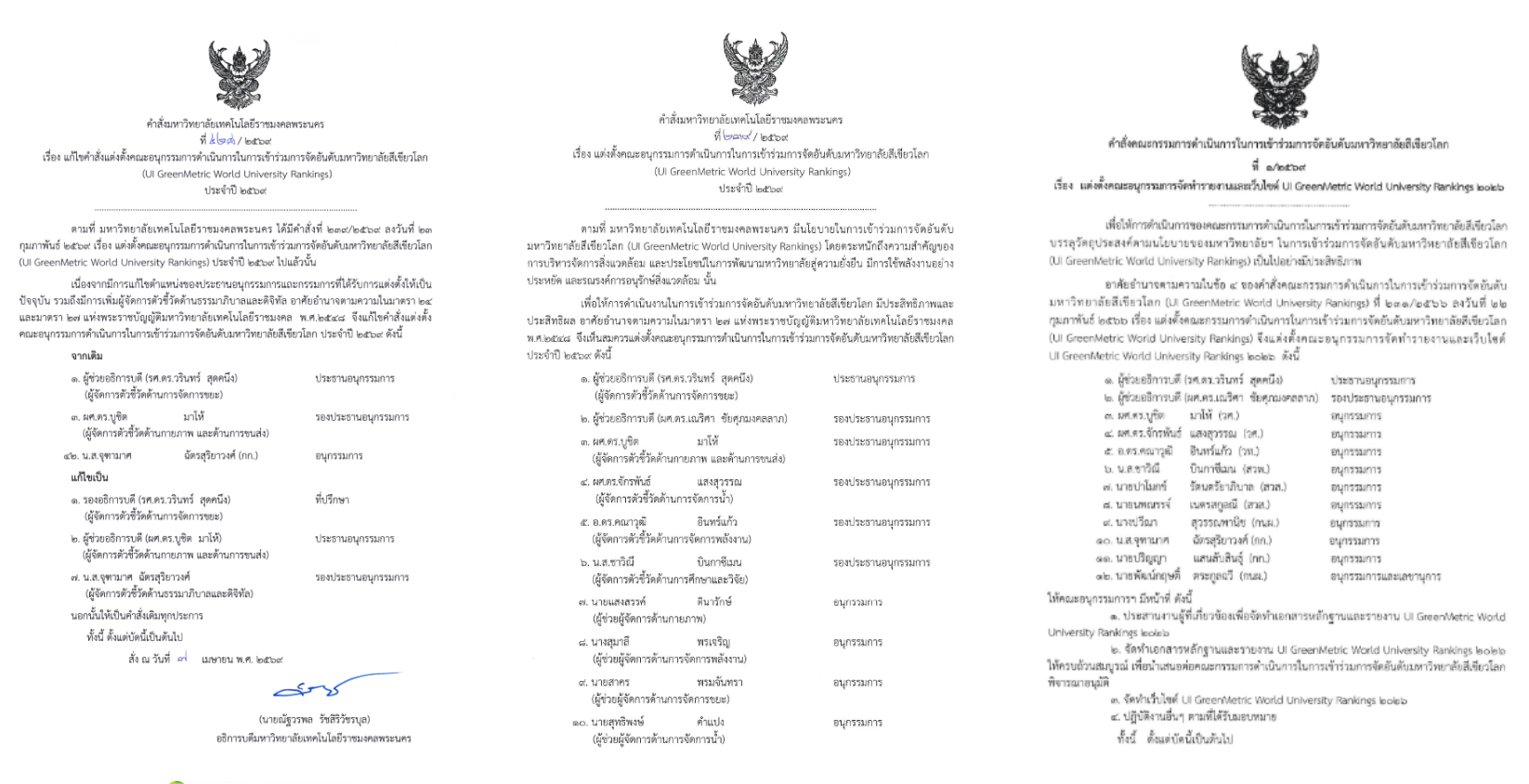
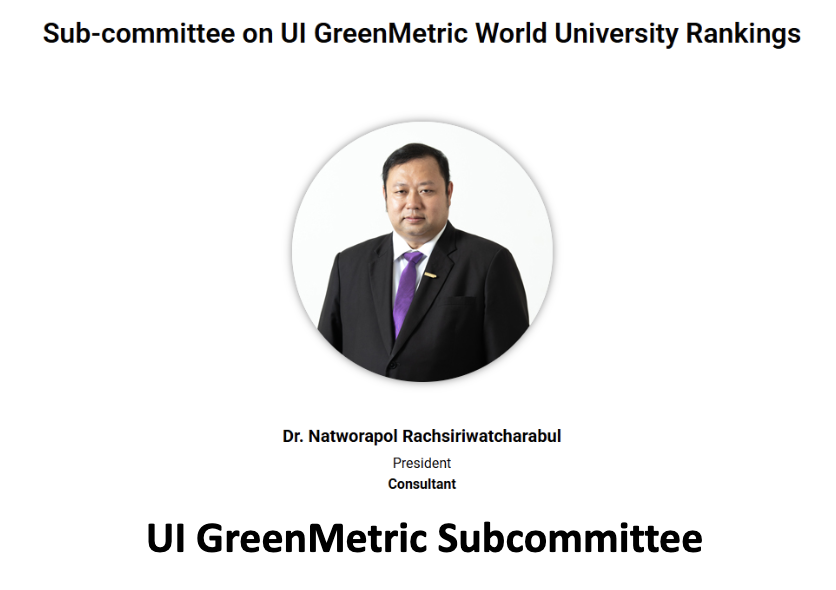
RMUTP has officially appointed a UI GreenMetric Subcommittee to directly oversee and coordinate the university’s participation in the UI GreenMetric World University Rankings. This committee serves as a direct institutional mechanism for sustainability on campus and is responsible for coordinating sustainability data, evidence, reporting, website preparation, and improvement planning according to UI GreenMetric criteria.
The subcommittee includes representatives responsible for key sustainability indicators, such as waste management, setting and infrastructure, transportation, water management, energy management, education and research, and other relevant operational areas. Its responsibilities include collecting documents and supporting evidence, preparing the UI GreenMetric report, developing the UI GreenMetric website, preparing improvement plans based on the ranking criteria, and carrying out other assigned tasks.
Through this committee, RMUTP ensures that sustainability implementation is coordinated across faculties, offices, and campuses. The UI GreenMetric Subcommittee also strengthens institutional monitoring, evidence-based reporting, and continuous improvement of campus sustainability performance.
Implementation of sustainability programs through the utilization of Information and Communication Technology (ICT) aligned with UI GreenMetric criteria (GD.6)
Section A — ICT for sustainability management: screenshots of sustainability dashboard/reporting system/KPI platform (showing real modules/menus).
| No | Initiative | Function | Brief Description | Screenshot or link of evidenc |
|---|---|---|---|---|
| 1 | RMUTP Green / UI GreenMetric Website | Sustainability reporting & evidence management | Public website used to organize sustainability information according to UI GreenMetric categories, including Setting and Infrastructure, Energy and Climate Change, Waste, Water, Transportation, Education & Research, Sustainability Report, and Results. | https://green.rmutp.ac.th/ |
| 2 | Water and Electrical Usage Dashboard | Monitoring & evaluation | Digital dashboard used to visualize monthly water and electrical consumption, compare data across departments/campuses, and support data-driven management. | https://ppd.offpre.rmutp.ac.th/dashbord-ppd-02/ |
| 3 | Solar Energy Dashboard | Renewable energy monitoring & evaluation | Digital dashboard used to monitor solar energy generation, solar-related billing information, electricity savings, and energy performance. | https://ppd.offpre.rmutp.ac.th/rmutp-solar-4campus/ |
| 4 | Annual Government Action Plan Performance Report | Monitoring, Evaluation & KPI Reporting | An official annual performance reporting system/document prepared by the Policy and Planning Division to monitor and report university performance against the annual government action plan. | รายงานผลตามแผนปฏิบัติราชการ |
Section B — Connectivity readiness: Wi-Fi coverage summary (map/list), Internet/network availability snapshot, and (if available) monitoring screenshots.
| No. | Initiative | Function | Brief Description | Screenshot or link of evidence |
|---|---|---|---|---|
| 1 | RMUTP Portal | Central access to digital systems | Central platform that allows students, staff, and related users to access university E-Services through a single point. | https://portal.rmutp.ac.th/ |
| 2 | RMUTP Passport | Authentication & user access | Institutional account used for access to university ICT services, including Wi-Fi, portal, and digital systems. | https://portal.rmutp.ac.th/passport |
| 3 | Campus Wi-Fi Services | Connectivity support | Wi-Fi services are provided for students, academic staff, and personnel to support online learning, reporting, administration, and digital services. | Library services |
| 4 | Google for Education / Office 365 | Digital collaboration & online work | Supports digital teaching, communication, document collaboration, and paperless operation for students and staff. | https://google.rmutp.ac.th |
Section C — Infrastructure reliability and security: backup/continuity summary, access control/security policy excerpt, monitoring snapshot.
| No | Initiative | Function | Brief Description | Screenshot or link of evidence |
|---|---|---|---|---|
| 1 | Role-Based Digital Services in RMUTP Portal | Governance & service delivery | Portal provides different service functions for students and staff, such as student card, timetable, activity transcript, attendance, personal data, e-Payslip, leave approval, car booking approval, and room booking approval. | https://portal.rmutp.ac.th/ |
| 2 | PDPA Compliance Framework | Data protection & privacy governance | RMUTP has a central PDPA webpage, personal data protection policy, committee, privacy notices, consent forms, data subject rights request form, and PDPA compliance checklist. | https://www.rmutp.ac.th/pdpa |
| 3 | CCTV Status Monitoring | Safety & infrastructure monitoring | NOC provides CCTV status information, supporting monitoring of digital safety infrastructure. | https://noc.rmutp.ac.th/ |
| 4 | IT Care Service | ICT maintenance & user support | Provides technical support for students and staff, helping maintain digital service reliability. | contact ARIT |
| 5 | Web Hosting RMUTP | Digital service infrastructure | Provides server space for students and staff to create websites for teaching and learning. | Web Hosting Service Request Form |
Policy on advanced digital technologies (AI/IoT, etc.) to support decision-making, efficiency, and service delivery (GD.7)
The university’s digital transformation is guided by the Strategic Plan of the Office of Academic Resource and Information Technology for 2023–2027. The plan provides a formal policy framework for developing digital platforms, IT infrastructure, digital learning resources, data warehouse systems, and integrated information technology services to support the university’s transition toward a digital university. The plan emphasizes the development of digital platforms that can be connected and applied across the university, as well as data warehouse systems that support further analysis and knowledge creation for future digital government integration.
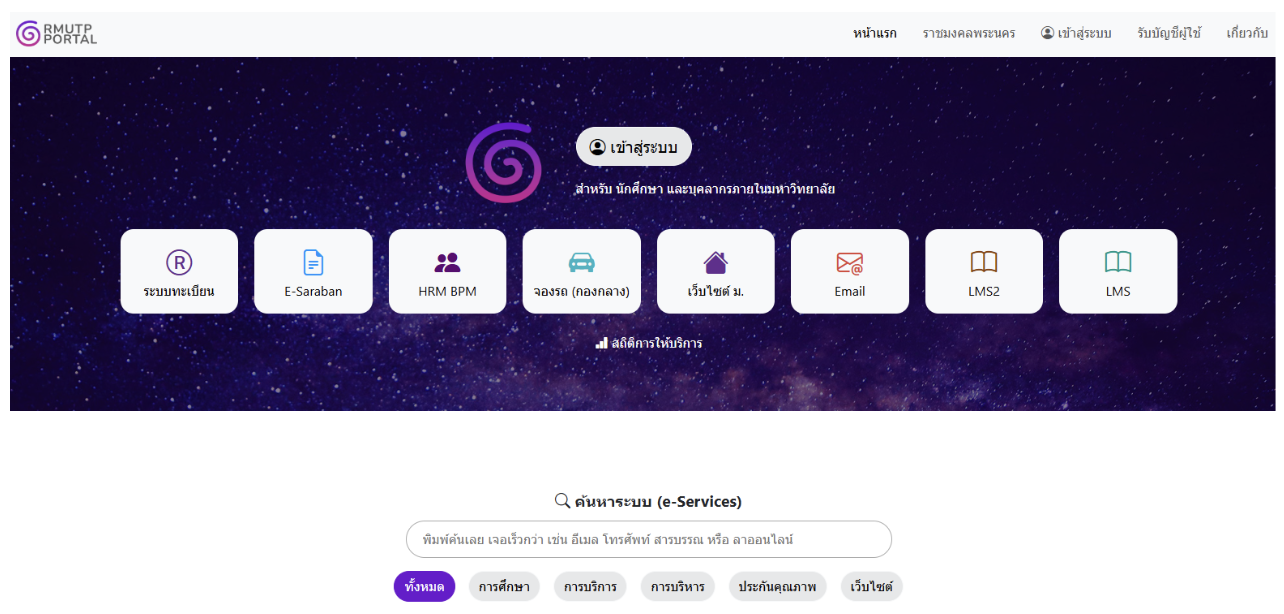
RMUTP has implemented digital services across core university functions through the RMUTP Portal and E-Services platform. These systems provide centralized access to university information systems for students, academic staff, and administrative staff. The RMUTP Portal supports Single Sign-On, RMUTP Passport account management, role-based service display, student services, staff services, e-Payslip, online leave approval, car booking approval, room booking approval, class attendance, LMS access, and other digital services. These platforms demonstrate that digitized services are not isolated pilots but are implemented across student services, academic administration, human resource management, facility booking, communication, and administrative operations.
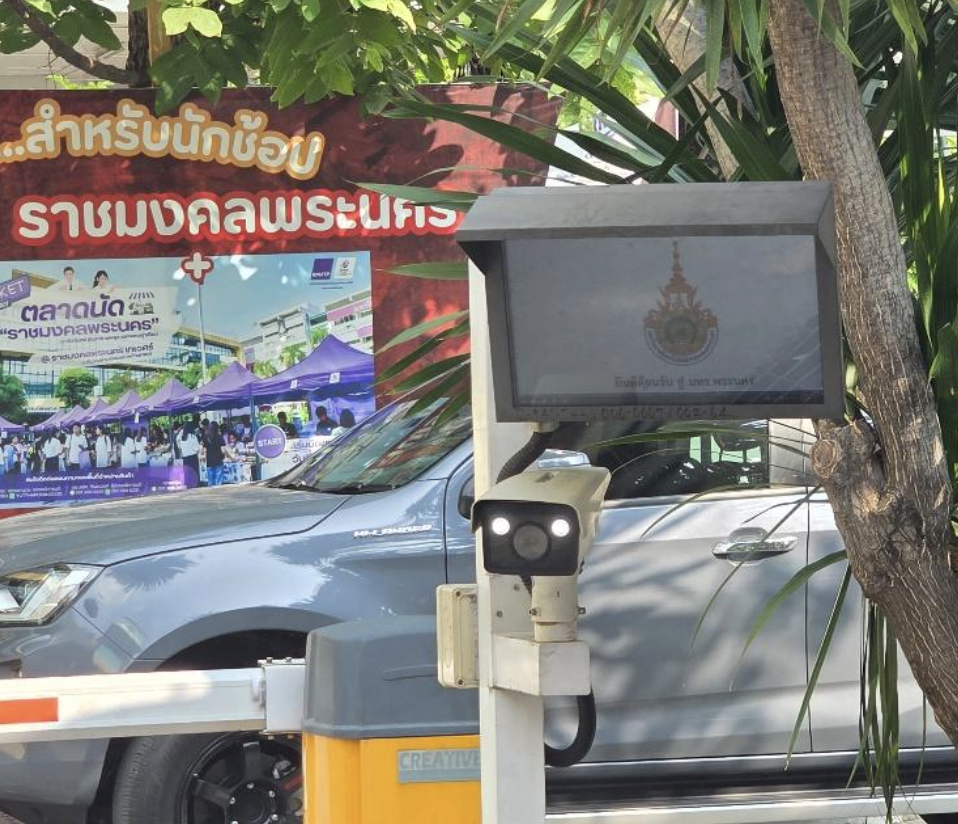
RMUTP also applies advanced digital technologies in campus operations. In transportation management, the university has implemented a License Plate Recognition (LPR) system to automatically capture and digitize vehicle license plates, manage vehicle permission databases, monitor parking availability and violations, and support real-time decision-making through a digital dashboard. The system improves traffic control, parking management, campus security, and operational efficiency.
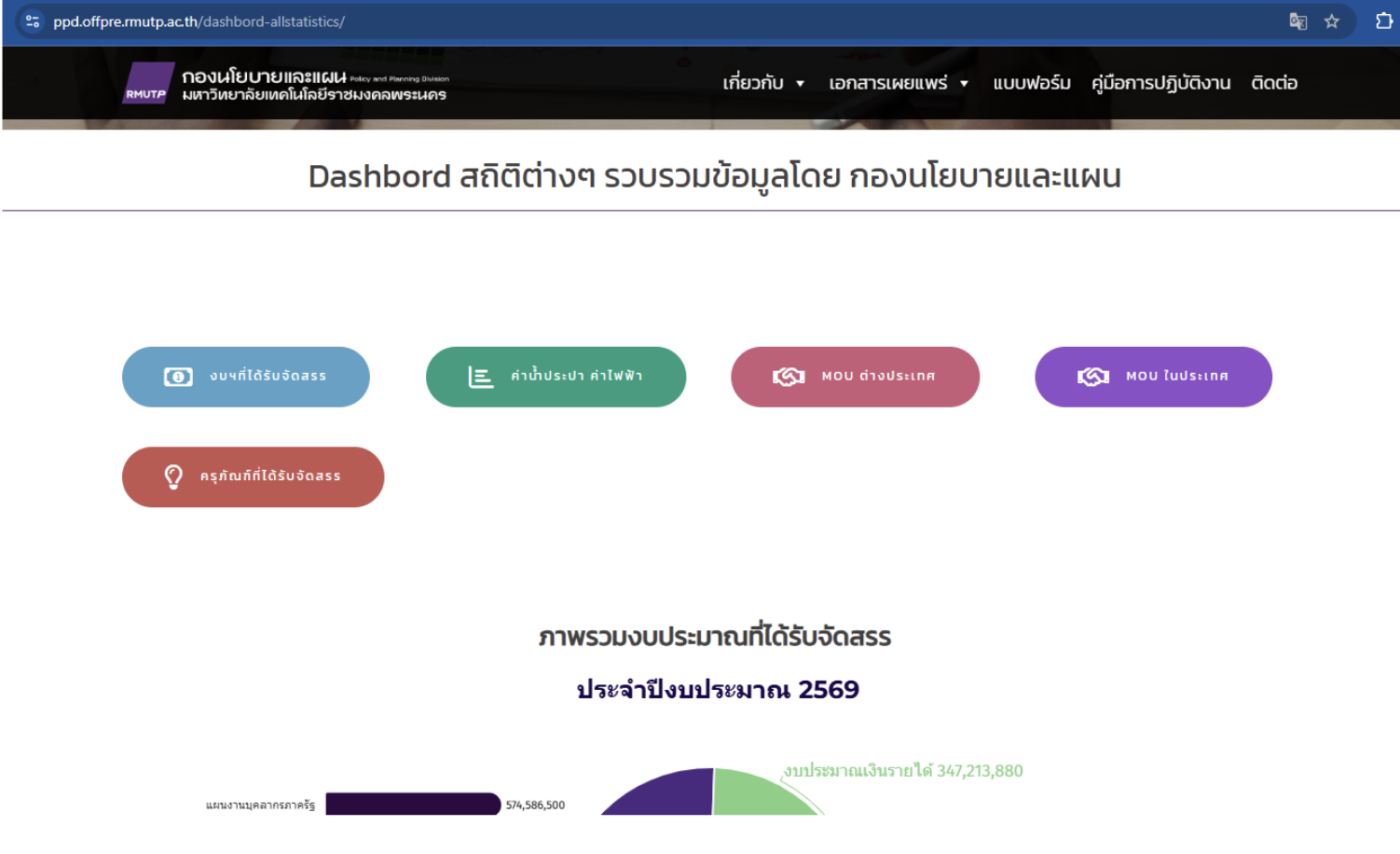
For institutional planning and decision-making, RMUTP uses dashboard and KPI-related digital platforms managed by the Policy and Planning Division. These include the institutional statistics dashboard, Business Intelligence (BI) system, Budget Planning and Management (BPM) system, Human Resource Management (HRM) system, Internal Quality Assurance (IQA) monitoring system, eMENSCR national monitoring system, and Individual Development Plan system. These platforms support planning, budgeting, monitoring, evaluation, personnel development, quality assurance, and evidence-based decision-making.
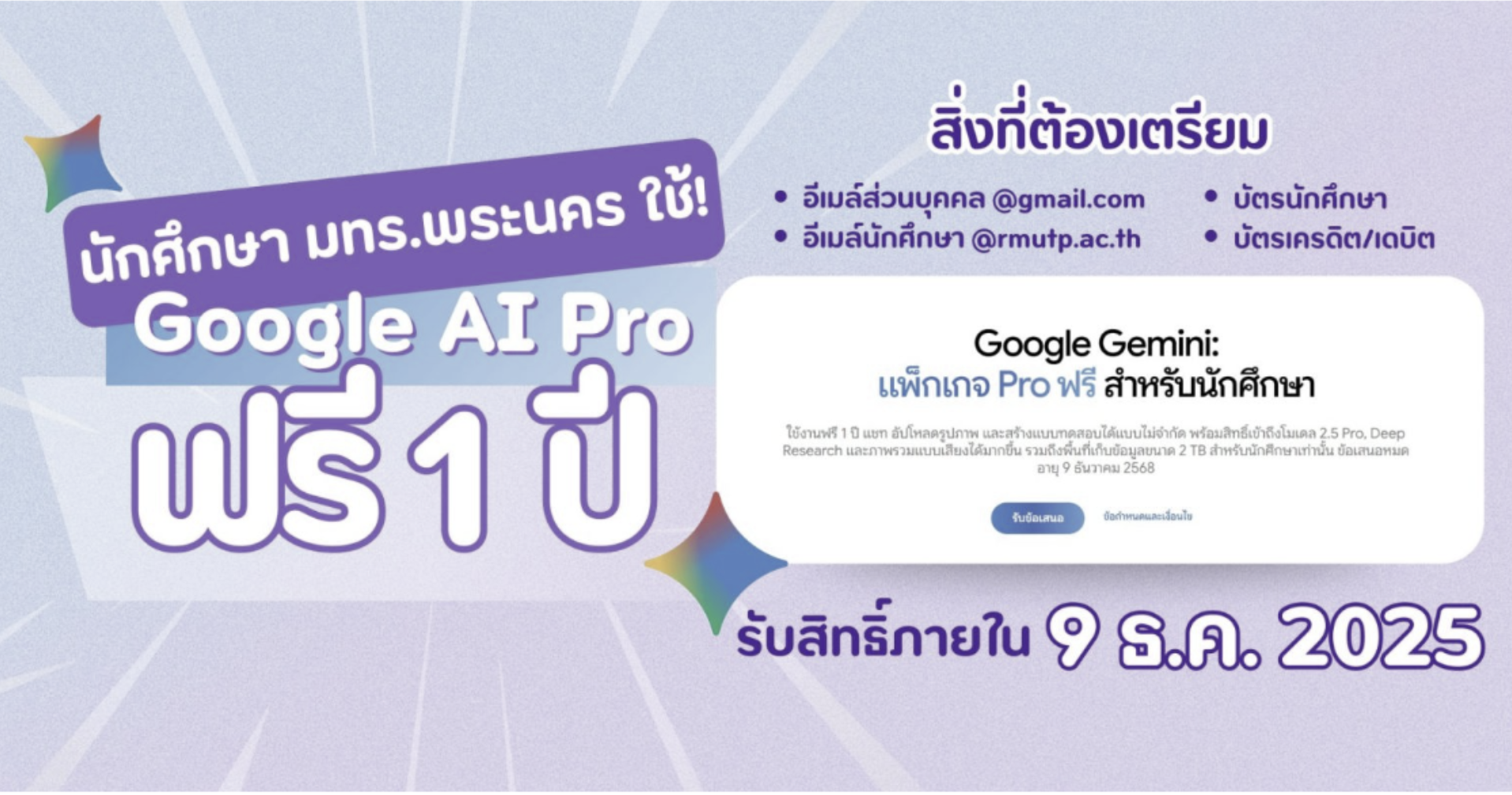
RMUTP also provides institutional support for the practical use of Artificial Intelligence (AI) by academic staff, administrative staff, and students. This support is implemented through university-organized training programs, digital knowledge resources, and AI-related learning activities. The university encourages the responsible use of AI tools to improve teaching and learning, media production, content creation, administrative work, communication, research support, and service delivery.
Compliance with the General Data Protection Regulation (GDPR) or Equivalent National Data Protection Regulations
Data Protection Policy
Description:
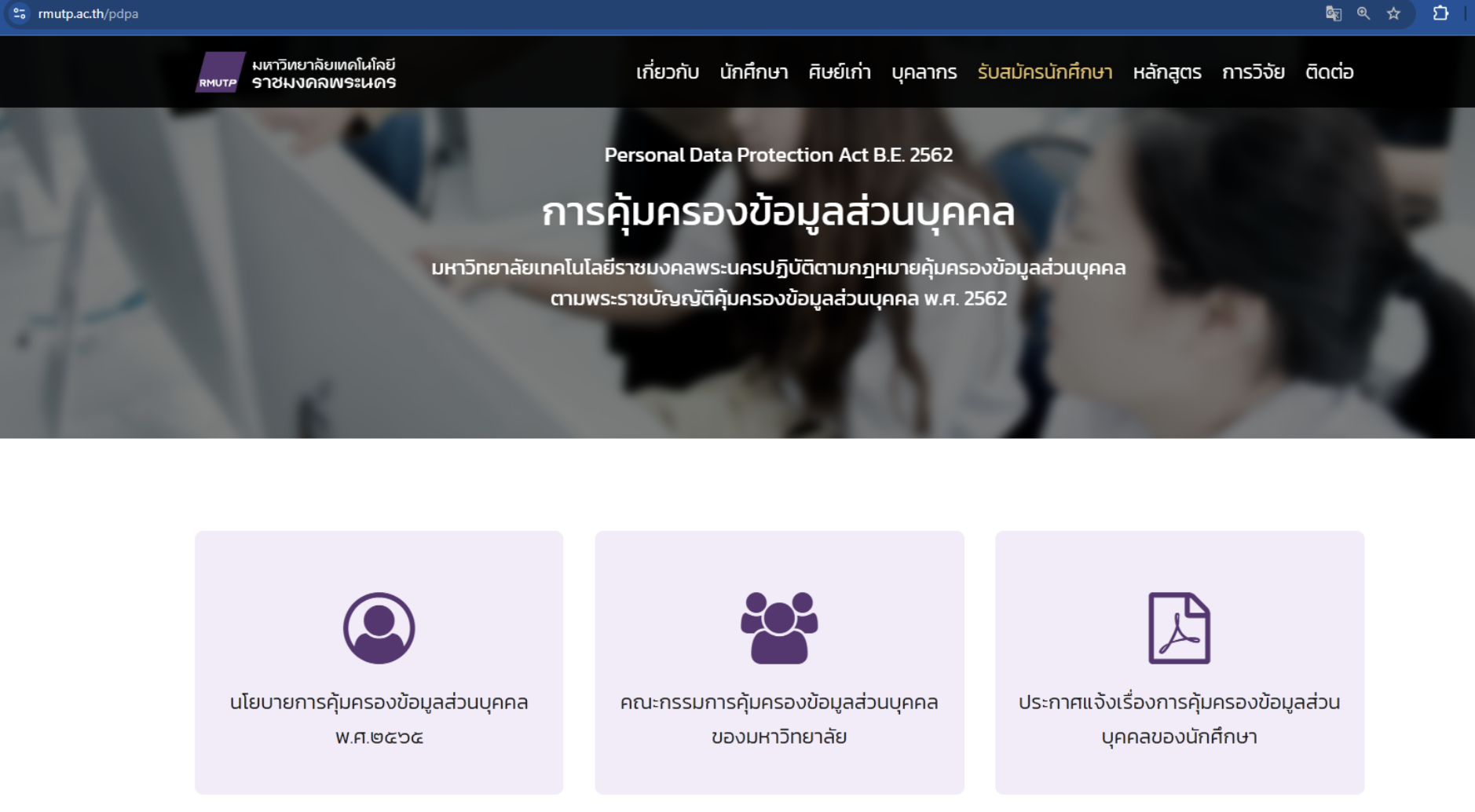
Rajamangala University of Technology Phra Nakhon (RMUTP) has fully implemented a data protection compliance framework in accordance with Thailand’s Personal Data Protection Act B.E. 2562 (2019), which is the national data protection regulation equivalent to GDPR in the Thai context.
RMUTP provides a dedicated Personal Data Protection webpage as the central platform for communicating its data protection policy, procedures, notices, consent mechanisms, and contact channels. The university has issued an institutional Personal Data Protection Policy and has established a Personal Data Protection Committee / Data Protection Officer mechanism to oversee privacy governance and compliance across university operations.
The university has also published privacy notices for major data subject groups and processing contexts, including students, university personnel, and CCTV surveillance. These notices explain the collection, use, processing, disclosure, retention, and protection of personal data, as well as the rights of data subjects under the PDPA.
RMUTP also provides an official contact channel for personal data protection inquiries through the Office of Academic Resource and Information Technology, including telephone contact and a dedicated PDPA email address. These mechanisms demonstrate that data protection compliance is not only documented but also implemented, monitored, and maintained at the institutional level.
Additional evidence link (i.e., for videos, more images, or other files that are not included in this file): https://www.rmutp.ac.th/pdpa
Ratio of Female Leaders to Total Institutional Leaders (GD.8)
Data Protection Policy
Description:
Additional evidence link (i.e., for videos, more images, or other files that are not included in this file):
https://www.rmutp.ac.th/rmutp-staff
https://www.rmutp.ac.th/rmutp-staff#
Anti-Corruption and Integrity System of the University (GD.9)
Anti-corruption and integrity system of RMUTP
ITA results
Description:
Rajamangala University of Technology Phra Nakhon (RMUTP) has established and implemented an anti-corruption and integrity system to promote transparency, accountability, ethical conduct, and good governance across the university. The system is supported by institutional policies, regulations, responsible units, reporting mechanisms, integrity programs, and continuous monitoring through national integrity assessment processes.
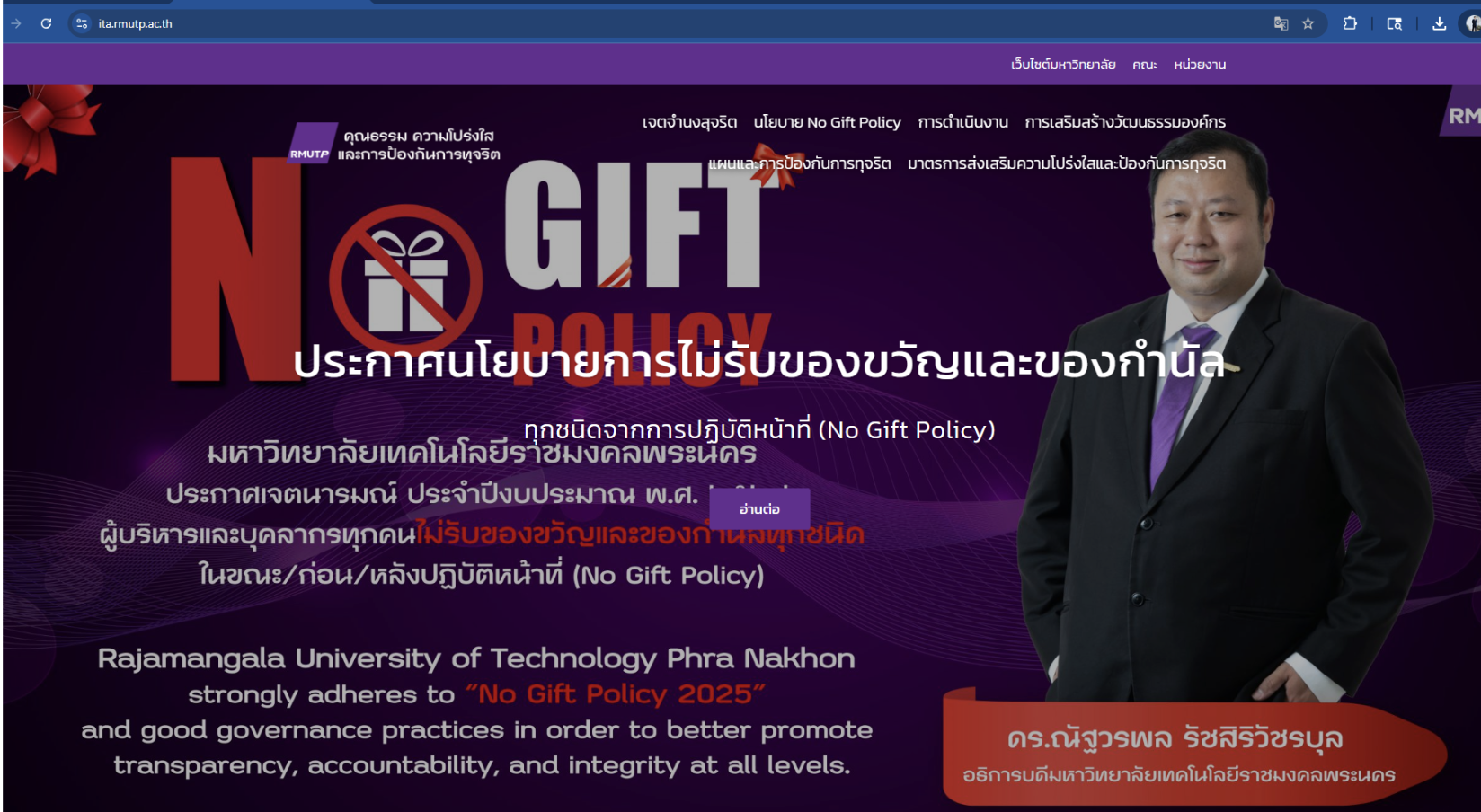
RMUTP publicly communicates its anti-corruption and integrity measures through the university’s Integrity and Transparency Assessment (ITA) platform. This platform provides information on anti-corruption policies, transparency measures, No Gift Policy, integrity activities, and relevant evidence for public access. The university has also formally announced its commitment to being an integrity-based organization and to prohibiting the acceptance of gifts or benefits from the performance of official duties.
The university implements a No Gift Policy to prevent conflicts of interest and reduce corruption risks. University executives, academic staff, administrative staff, and relevant personnel are encouraged to perform their duties with honesty, impartiality, transparency, and accountability, without accepting gifts, rewards, or other benefits related to official responsibilities.
RMUTP also has formal reporting and complaint mechanisms for corruption, misconduct, disciplinary matters, and ethical violations. Complaints can be submitted through the university’s online complaint system, complaint boxes, direct telephone channels, and official written channels. The university has issued written procedures for handling corruption and misconduct complaints, covering complaint receiving, initial review, fact-finding, investigation, reporting, disciplinary consideration, and feedback to complainants. The procedures also include confidentiality protection for complainants and whistleblowers.
In terms of institutional implementation, RMUTP appoints responsible committees and subcommittees to supervise and monitor integrity and transparency operations under the ITA framework. These mechanisms help ensure that anti-corruption measures are implemented, monitored, evaluated, and improved on a regular basis.
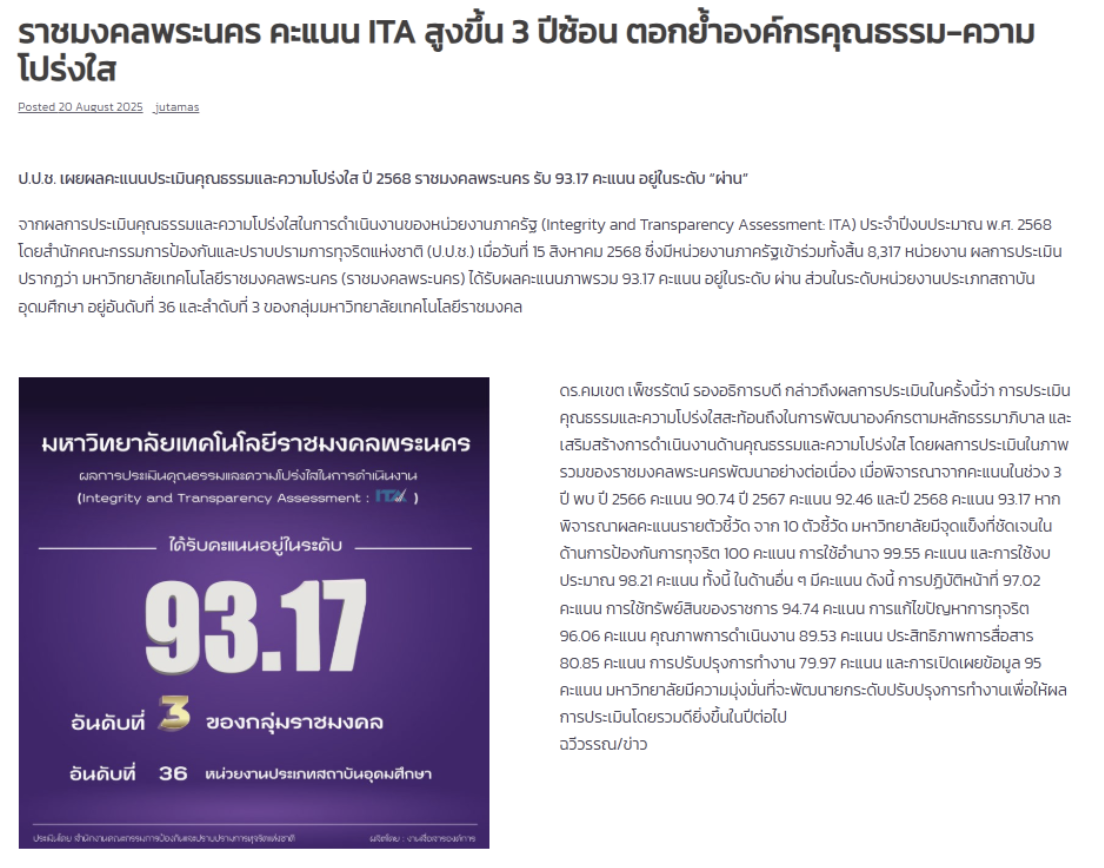
RMUTP’s commitment to integrity is also reflected in its national ITA performance. The university has continuously improved its ITA results over the past three years and achieved a high level of performance in the most recent assessment. This demonstrates that anti-corruption and integrity systems are not only documented but also actively implemented and monitored across the university.
Additional evidence link (i.e., for videos, more images, or other files that are not included in this file):
https://www.rmutp.ac.th/ita68
LMS-Enabled Digital Literacy Program (GD.11)
Digital Literacy programs at RMUTP: E-Services, Digital Literacy, Digital learning platform, LMS-RMUTP
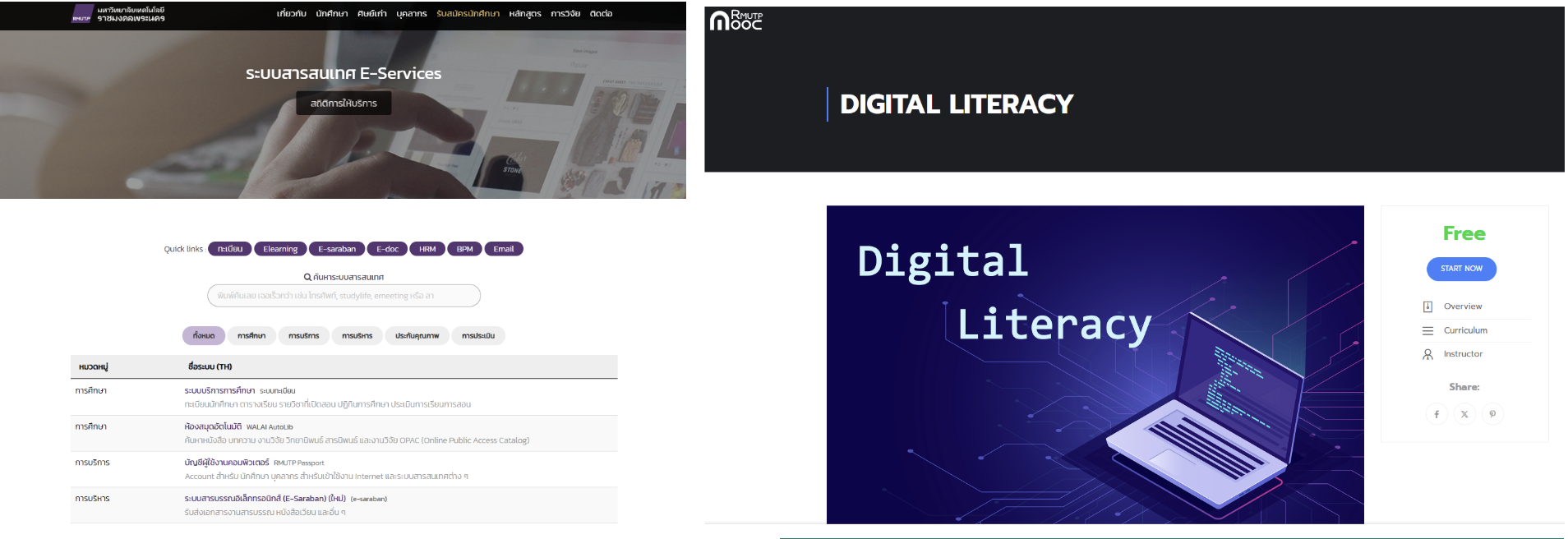
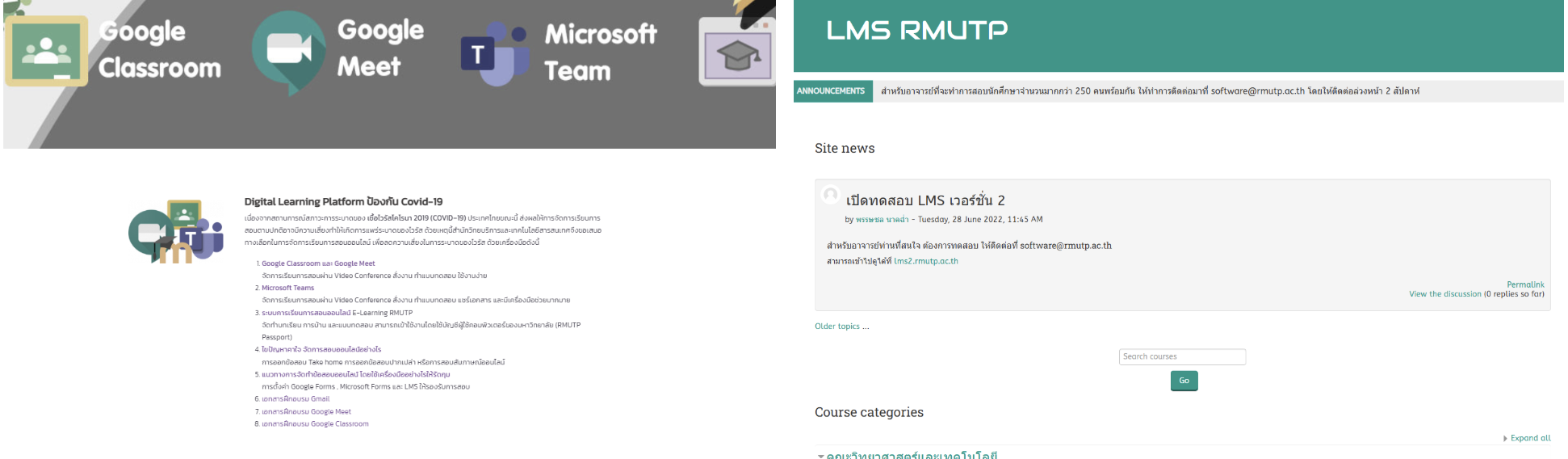
Description:
Rajamangala University of Technology Phra Nakhon (RMUTP) has implemented LMS-enabled digital literacy programs for students, academic staff, and administrative staff as part of its digital university development and teaching innovation strategy. The university provides digital learning platforms, online courses, training materials, and support systems to enhance digital skills and promote the responsible use of technology across the institution.
RMUTP operates its Learning Management System through E-Learning RMUTP, which is based on Moodle. The LMS supports online teaching and learning, course content management, assignments, quizzes, learning resources, communication tools, online examinations, and live-streaming functions. This system enables academic staff to manage digital courses and allows students to access learning materials and activities through an online platform.
In addition, RMUTP provides RMUTP MOOC as an open online learning platform. One of the key courses available on this platform is Digital Literacy, which is designed to develop fundamental digital competencies. The course covers topics such as basic digital literacy concepts, computer and device skills, operating systems, applications, file and folder management, internet use, websites, web browsers, URLs, online registration, authentication, e-mail, and search engines. These topics support students and staff in developing essential skills for learning, working, communication, and responsible participation in the digital environment.
RMUTP also supports academic staff through LMS-related training and user guides. These include guidance on creating online courses, managing course content, uploading learning resources, adding activities, using quizzes, managing online classrooms, and using Microsoft Teams for communication, online meetings, assignments, and collaborative learning. These initiatives help instructors design and deliver digital learning more effectively.
For administrative staff, RMUTP promotes digital literacy through the use of university digital systems and online service platforms. Staff are encouraged to use digital tools for document management, communication, online meetings, service delivery, and internal operations. This supports more efficient, transparent, and paperless administrative work.
The implementation of LMS-enabled digital literacy programs is supported by the Office of Academic Resource and Information Technology, which is responsible for digital learning systems, ICT infrastructure, user support, and digital transformation initiatives. These programs contribute to improving digital competency, teaching quality, learning accessibility, operational efficiency, and the responsible use of technology among students and staff.
Additional evidence link (i.e., for videos, more images, or other files that are not included in this file):
https://www.rmutp.ac.th/e-services/
https://mooc.rmutp.ac.th/courses/digital-literacy/
https://arit.rmutp.ac.th/covid19/
https://lms.rmutp.ac.th/
Whistle Blowing and Complaint System of the University (GD.10)
Complaint System
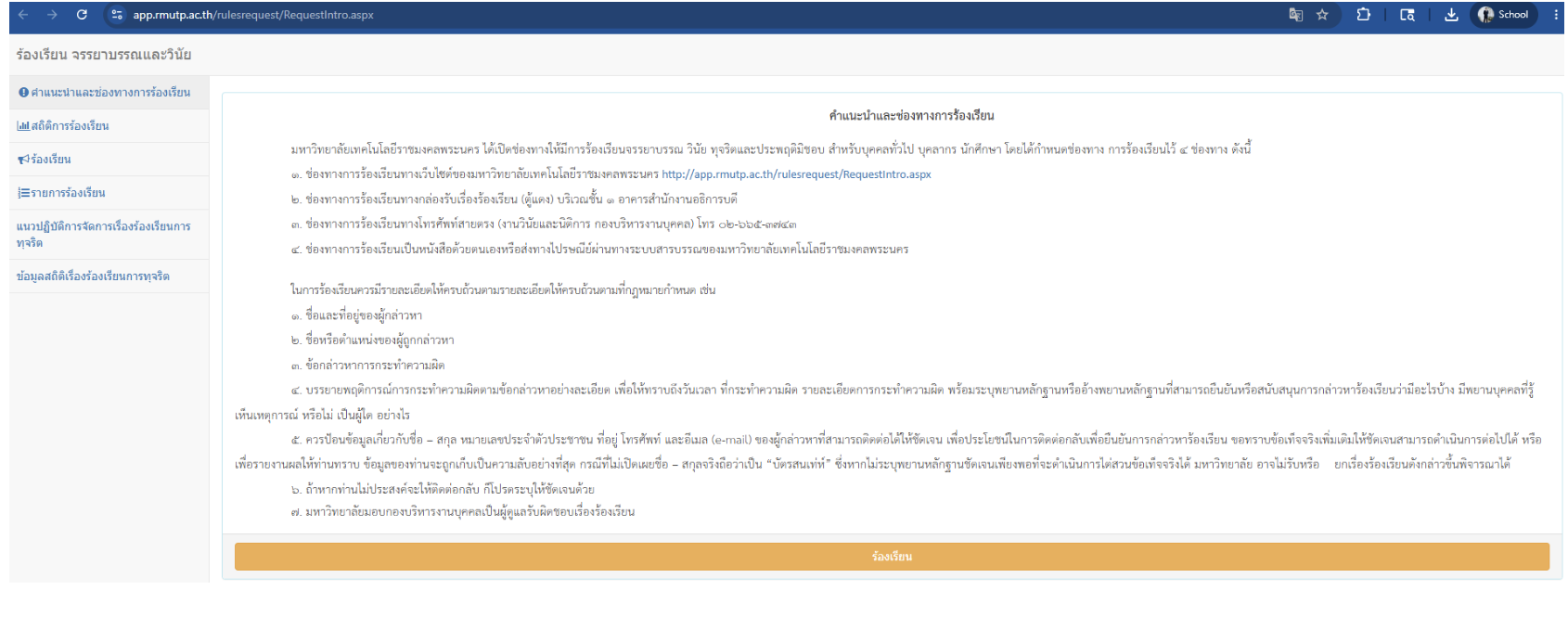
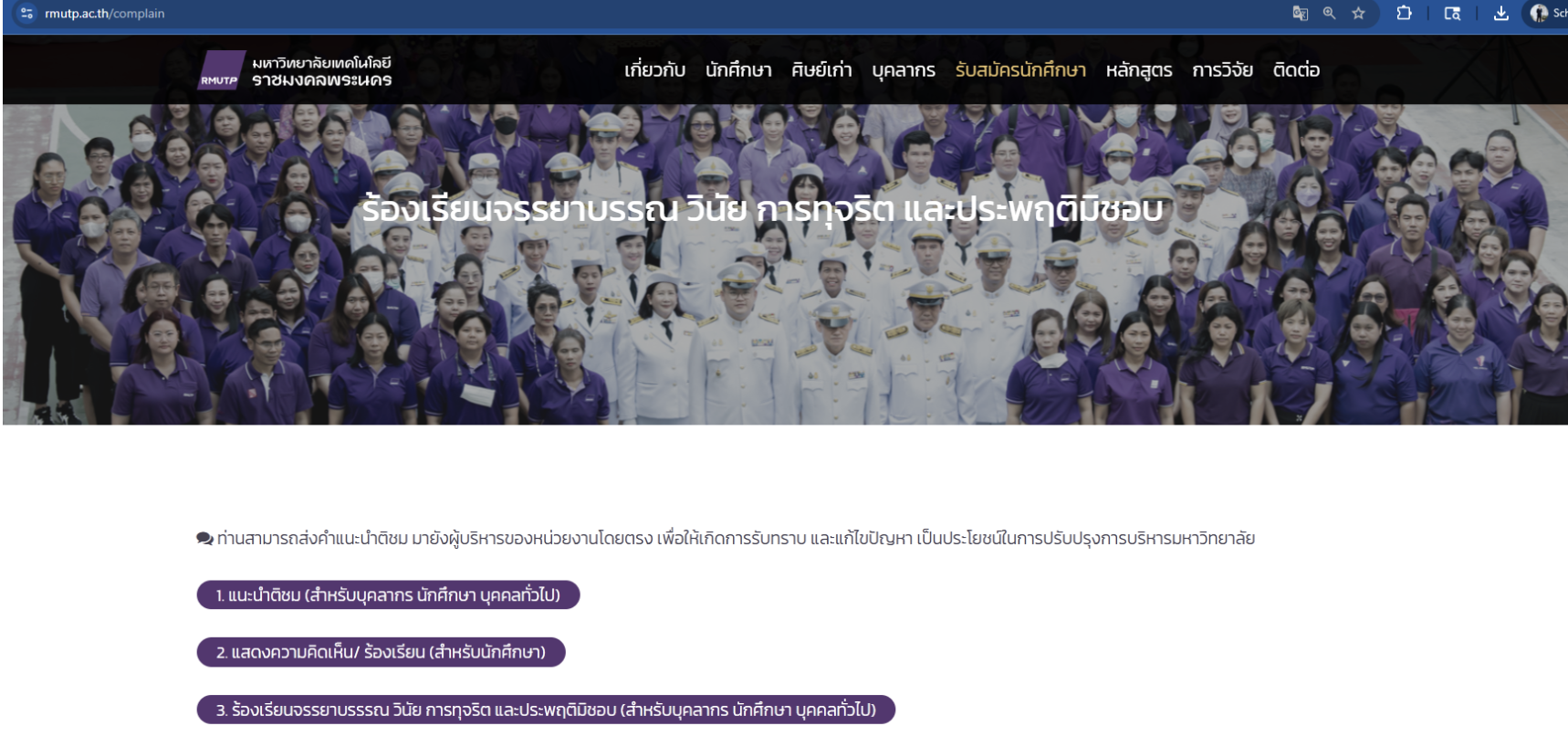
procedures for handling complaints
Description:
Rajamangala University of Technology Phra Nakhon (RMUTP) has established and implemented formal whistleblowing and complaint systems to support transparency, accountability, ethical conduct, and good governance across the university. The system is available for university personnel, students, and the general public to report complaints related to ethics, disciplinary matters, corruption, misconduct, and inappropriate behavior.
RMUTP provides multiple official reporting channels, including an online complaint system through the university website, a physical complaint box located at the Office of the President, a direct telephone channel through the Discipline and Legal Affairs Section of the Human Resource Management Division, and written complaints submitted through the university’s official document system. These channels ensure that complainants can access the system through both online and offline methods.
The university has also published formal procedures for handling complaints related to corruption and misconduct. The procedures define responsible officers, complaint categories, receiving channels, monitoring frequency, processing timelines, investigation steps, and reporting mechanisms. After a complaint is received, the responsible officer reviews the information and submits the case to the President for further consideration. Where necessary, the university may assign relevant units to investigate the facts or appoint a fact-finding committee. If the complaint is found to have merit, further disciplinary procedures will be undertaken in accordance with university regulations.
RMUTP also provides protection for complainants and whistleblowers by keeping personal information confidential. The identity, address, and related information of the complainant are protected and may not be disclosed to unauthorized persons, except where disclosure is required by law or official duty. This mechanism helps encourage reporting while reducing risks to complainants.
In addition, RMUTP’s complaint and disciplinary framework covers serious misconduct, including sexual harassment and inappropriate sexual behavior. The university’s code of ethics and student disciplinary regulations prohibit sexual harassment and related misconduct, and such matters can be reported through the university’s complaint and disciplinary channels.
Additional evidence link (i.e., for videos, more images, or other files that are not included in this file):
https://www.rmutp.ac.th/complain
https://app.rmutp.ac.th/rulesrequest/RequestIntro.aspx
Written Code of Ethics that applies to university leaders, academic staff, administrative staff, and students (GD.12)
Code of Ethics rule at RMUTP 2023
Description:
ajamangala University of Technology Phra Nakhon (RMUTP) has established written codes of ethics and related institutional regulations that apply to university leaders, academic staff, administrative staff, students, and other persons involved in university operations. The university provides official ethics documents through its
public ethics webpage, including the RMUTP Code of Ethics B.E. 2566 (2023), the Code of Ethics for Civil Servants in Higher Education Institutions, ethical guidelines based on good governance principles, and relevant institutional regulations.
The RMUTP Code of Ethics provides a formal framework for promoting integrity, responsibility, transparency, professionalism, respect, and accountability within the university community. It serves as a common ethical standard for university executives, academic personnel, support staff, students, and individuals performing duties related to the university’s missions.
To support implementation, RMUTP has established mechanisms for ethical governance, including the appointment of an ethics advisory committee, publication of Dos and Don’ts guidelines, ethics-related training activities, and integration of ethical principles into human resource management and institutional operations. These mechanisms help ensure that ethical standards are not only documented but also communicated, promoted, and applied in practice.
RMUTP also promotes integrity and transparency through related institutional measures, such as the No Gift Policy, which prohibits giving or receiving gifts or benefits related to official duties. This policy reinforces ethical behavior, prevents conflicts of interest, and strengthens a culture of honesty and accountability across the university.
Additional evidence link (i.e., for videos, more images, or other files that are not included in this file):
https://www.rmutp.ac.th/ethics/